
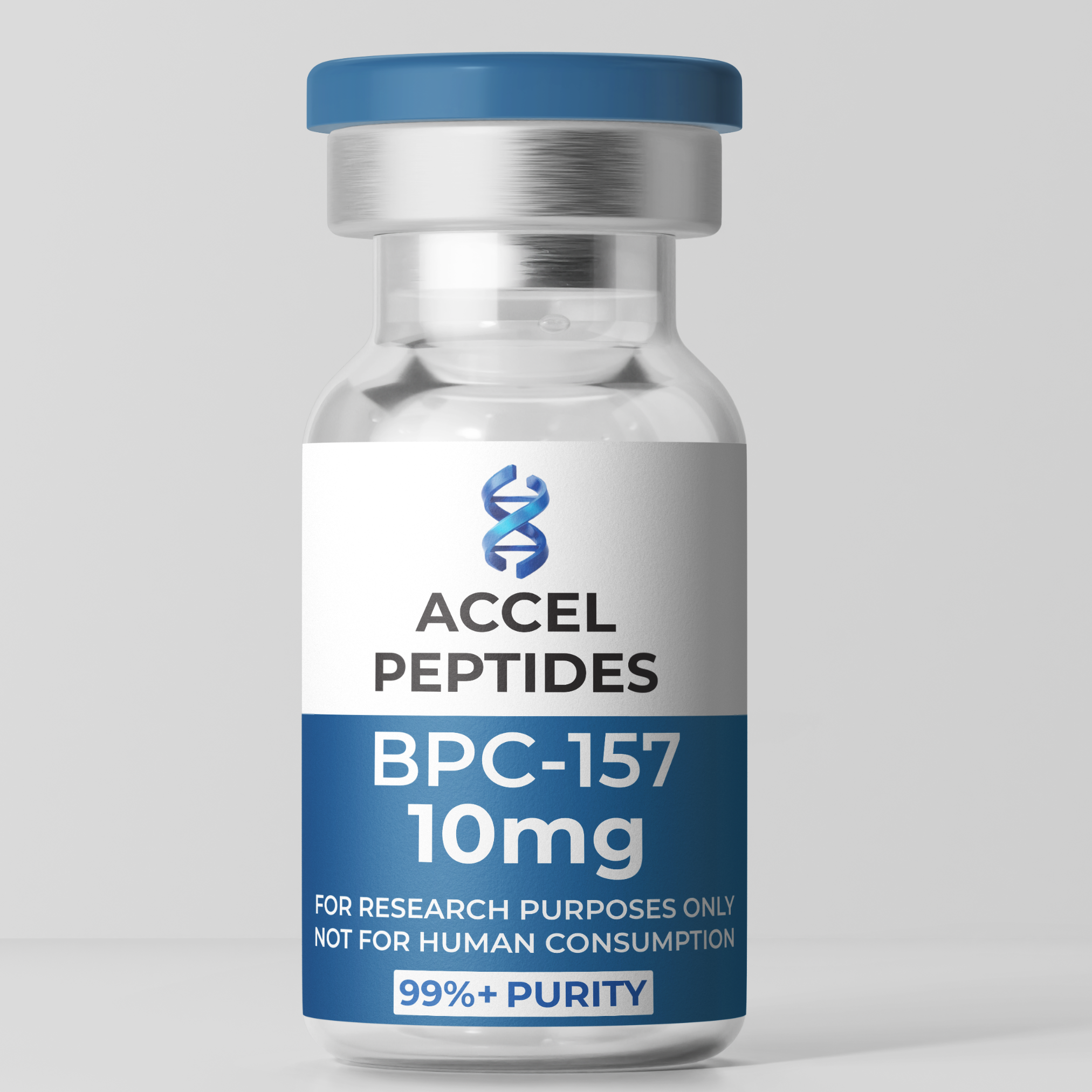
BPC-157 (10mg)

$119.00

BPC-157 is a pentadecapeptide derived from gastric proteins. Research focuses on its chemical
properties related to angiogenesis, tissue repair signaling, and anti-inflammatory modulation in
musculoskeletal and gastrointestinal laboratory models.

Availability: In Stock

Description

Description

BPC-157 (Body Protection Compound)

ULTRA-HIGH PURITY
MANUFACTURER ID: WF03 BATCH ID: BP20250808 ✓ HPLC PURITY: 99.99%
Cost per Milligram $3.60 – $4.80
Endotoxin Status Certified Endotoxin-Safe
Molecular Profile Synthetic Pentadecapeptide (15 Amino Acids)
Independent Validation Yes - Verified & Tested
Scientific Research Monographs // Educational Use Only
Upregulation of Growth Hormone (GH) Receptors
Source: Molecules (MDPI)
Scientific Findings In vitro studies on tendon fibroblasts show that BPC-157 significantly increases GH receptor expression at mRNA and protein levels. This action sensitizes cells to growth hormone, activating the JAK2 signaling pathway and accelerating cell proliferation critical for tendon repair.
Plain English Interpretation BPC-157 makes tendon cells much more sensitive to the body's natural growth hormone. By adding more "receiver sites" to the cells, it helps them grow and multiply faster to repair injuries more efficiently.
Pro-Angiogenic Mechanism & VEGFR2 Activation
Source: PubMed / Journal of Applied Physiology
Scientific Findings BPC-157 promotes the formation of new blood vessels (angiogenesis) by upregulating and internalizing the VEGFR2 receiver. This triggers the VEGFR2-Akt-eNOS signaling cascade, which is the primary molecular engine for endothelial tube formation and tissue vascularization.
Plain English Interpretation This peptide tells the body to build more "highways" (blood vessels) to an injured area. It does this by activating a specific switch on the surface of vessel cells, ensuring oxygen and nutrients can reach the site of repair.
Vasomotor Tone Modulation & Nitric Oxide Generation
Source: Nature (Scientific Reports)
Scientific Findings BPC-157 induces endothelium-dependent vasodilation through the activation of the Src-Caveolin-1-eNOS pathway. This process stimulates Nitric Oxide (NO) production, which relaxes blood vessels and promotes cellular migration toward damaged tissue.
Plain English Interpretation BPC-157 helps blood vessels relax and widen. By triggering the production of nitric oxide, it opens up the flow of blood, making it easier for repair cells to travel to where they are needed most.
RESEARCH NOTICE: For laboratory research and development only. Not for human consumption. Reference: AP-BPC157-2026.
Reviews (0)

Reviews

There are no reviews yet.

Be the first to review “BPC-157 (10mg)”

Your email address will not be published. Required fields are marked *

Storage Details
❄️

Stability & Storage Protocol

DOC ID: AP-STB-2026

Advanced Lyophilization Process

At Accel Peptides, we partner with manufacturing facilities specializing in Lyophilization (freeze-drying). This advanced process ensures compounds remain stable during transit and storage for over 12 months.

When kept in their freeze-dried state, these compounds stay effective for extended periods. For long-term preservation, we recommend storing them in the freezer to maintain maximum molecular integrity.

FDA Standard Requirement The common "discard 28 days after first use" guideline is a standard requirement set for multi-use vials to confirm bacteriostatic water retains its preservative qualities.
Accel Empirical Experience With strict sterile handling and refrigeration, a reconstituted vial can safely remain stable and effective for three months or longer.

*Stability is dependent on sterile technique and consistent temperature control.

REFRIGERATE AFTER RECONSTITUTION

Integrity Verified
Certificates of Analysis
Peptide Partners | Certificates of Analysis
13 Peptide COAs
Avg purity %
Lab: Freedom Diagnostics
Peptide / Blend Batch / Product Lot Accession No. Reported Date Purity (HPLC-MS) Laboratory Certificate